Multi-Tenant SaaS Architecture: Complete Guide, Models, Design Patterns, and Scaling Strategy
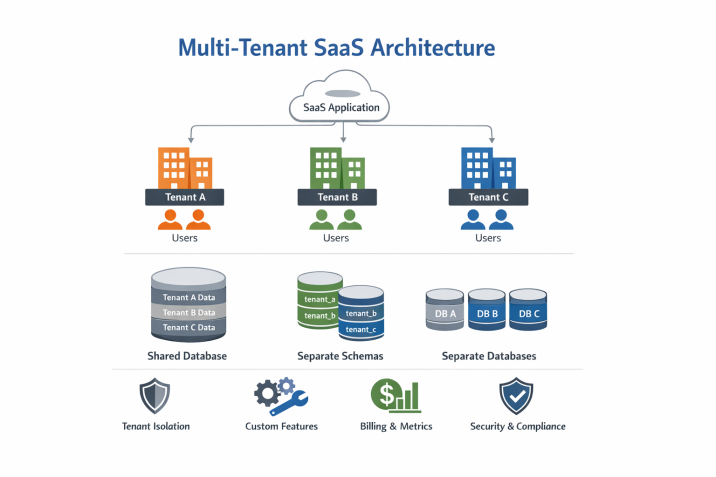
Multi-tenant SaaS architecture is a foundational concept in modern cloud software. It allows a single application instance to serve multiple customers while keeping their data logically isolated. This approach reduces infrastructure cost, simplifies deployments, and enables scalable growth.
This guide explains multi-tenant SaaS architecture models, tenant isolation strategies, authentication design, scaling patterns, and security considerations.
What Is Multi-Tenant SaaS Architecture?
Multi-tenancy means multiple customers (tenants) share the same application and infrastructure while their data and configurations remain separated. Each tenant experiences the system as if it were dedicated to them.
In contrast, single-tenant architecture provides a dedicated application instance for each customer, which is more expensive and harder to scale.
Core Multi-Tenancy Database Models
1. Shared Database, Shared Schema
All tenants share the same database and tables. Each record contains a tenant_id column to identify ownership.
- Lowest infrastructure cost
- Simple deployment and maintenance
- Higher risk of data leakage if tenant filters fail
- Complex performance tuning at scale
2. Shared Database, Separate Schema per Tenant
Each tenant has its own schema within the same database server. For example, tenant_1.users and tenant_2.users.
- Better isolation than shared schema
- Easier tenant-specific migrations
- Operational complexity increases with many tenants
3. Separate Database per Tenant
Each tenant gets a dedicated database instance.
- Strong isolation and security
- Independent backups and migrations
- Higher infrastructure cost and orchestration complexity
Tenant Identification and Resolution
The application must detect which tenant is making a request. Common approaches include:
- Subdomain-based: tenant1.app.com, tenant2.app.com
- Custom domains: clientdomain.com mapped via DNS
- Token-based: tenant_id stored in JWT or API headers
Subdomains are the most common and easiest to implement. Custom domains are often used for enterprise branding.
Authentication and Tenant-Aware Authorization
Multi-tenant systems require tenant-aware identity management. Users may belong to one or multiple tenants, and roles must be scoped per tenant.
Key requirements include:
- Role-based access control (RBAC) per tenant
- Tenant invitations and onboarding flow
- Super-admin or platform-level users
Feature Flags and Tenant Customization
Tenants often have different plans and configurations. Feature flags enable or disable features per tenant based on subscription tiers.
Typical tenant-specific configurations include:
- Branding and white-labeling
- Workflow customization
- Third-party integrations
Scaling Multi-Tenant SaaS Systems
Scaling multi-tenant platforms requires careful planning across compute, data, and traffic layers.
Compute Scaling
Use containerization and auto-scaling to handle tenant load dynamically.
Data Scaling
Techniques include sharding by tenant_id, read replicas, and tenant-specific databases.
Traffic Scaling
Use CDNs, caching, and rate-limiting per tenant to avoid noisy-neighbor issues.
Billing and Metering Architecture
Billing logic is deeply connected to multi-tenancy architecture. Common billing metrics include:
- Number of users
- API usage
- Storage consumption
- Feature-based pricing tiers
Accurate tenant metering is essential for SaaS revenue tracking.
Security Risks in Multi-Tenant Systems
Multi-tenancy introduces unique security challenges:
- Missing tenant filters causing data leaks
- Shared caches exposing cross-tenant data
- Logs and backups containing tenant-sensitive data
- Queue and job systems losing tenant context
Strict tenant scoping and automated testing are critical to prevent breaches.
Hybrid and Progressive Isolation Models
Many SaaS platforms use hybrid tenancy models:
- Small tenants share databases
- Medium tenants get dedicated schemas
- Enterprise tenants receive dedicated databases and infrastructure
This approach balances cost, performance, and security.
Conclusion
Multi-tenant SaaS architecture is not just a technical decision—it encodes business strategy, pricing, scalability, and risk management into software design. Choosing the right tenancy model early can save massive refactoring effort later.
Whether you build with PHP, Laravel, WordPress, or any modern framework, tenant-aware design patterns are essential for scalable SaaS platforms.
Need to build a Website or Application?
Since 2011, Codeboxr has been transforming client visions into powerful, user-friendly web experiences. We specialize in building bespoke web applications that drive growth and engagement.
Our deep expertise in modern technologies like Laravel and Flutter allows us to create robust, scalable solutions from the ground up. As WordPress veterans,
we also excel at crafting high-performance websites and developing advanced custom plugins that extend functionality perfectly to your needs.
Let’s build the advanced web solution your business demands.